Healthcare decisions are only as good as the data behind them. When a clinician reviews patient history or an analytics team identifies care improvement opportunities, they’re trusting that the underlying data is accurate, complete, and current. Yet medical devices generating this critical data—ventilators, monitors, imaging systems—often can’t reliably transmit what they capture to the systems where it’s needed.
This case examines how one healthcare organization created a unified edge-to-cloud framework that transforms device data from scattered, inconsistent information into trustworthy intelligence for clinical and operational decisions.
The Problem: Fragmented Device Data, Delayed Insights
The healthcare organization operated numerous medical devices across hospitals and care settings, each generating data critical for patient care and operational efficiency. But having devices and having usable data are fundamentally different challenges.
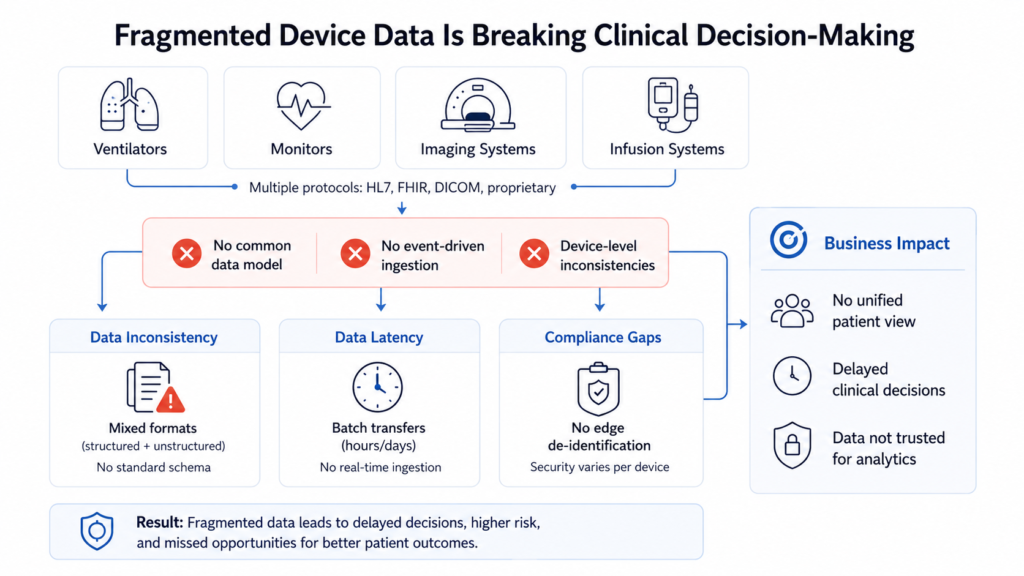
Medical data scattered across multiple modalities and locations. Ventilator data lived in one system, vital signs monitors in another, imaging devices in a third. Each modality used different protocols, making unified analysis nearly impossible.
Inconsistent data formats and quality across devices. Some devices transmitted structured data; others generated unformatted logs. Quality varied unpredictably. Analytics teams spent more time cleaning and reconciling data than analyzing it.
Delayed or unstructured data transfer to central systems. Critical device data arrived hours or days after generation—too late for real-time clinical decisions. Historical data was equally problematic, often requiring manual extraction and transfer.
Compliance challenges around security, privacy, and de-identification.Healthcare data moves under strict regulatory requirements. Without proper controls at the point of collection, organizations risk violations even when intentions are good. Each device integration required custom security implementation, creating inconsistent protection.
No unified pipeline existed to support real-time analytics and visualization. Each new device or use case required building custom data collection infrastructure, creating redundant effort and preventing strategic leverage of device data.
The result: limited visibility into patient status, slower clinical decisions, and valuable device data remaining underutilized because it couldn’t be trusted or accessed reliably.
The Solution: A Unified Edge-to-Cloud Data Transfer Framework
NeST Digital designed an end-to-end device data transfer platform to seamlessly collect, process, and move healthcare data—both real-time and historical—into a secure analytics environment. The architecture addressed immediate operational needs while ensuring compliance and creating reusable infrastructure.
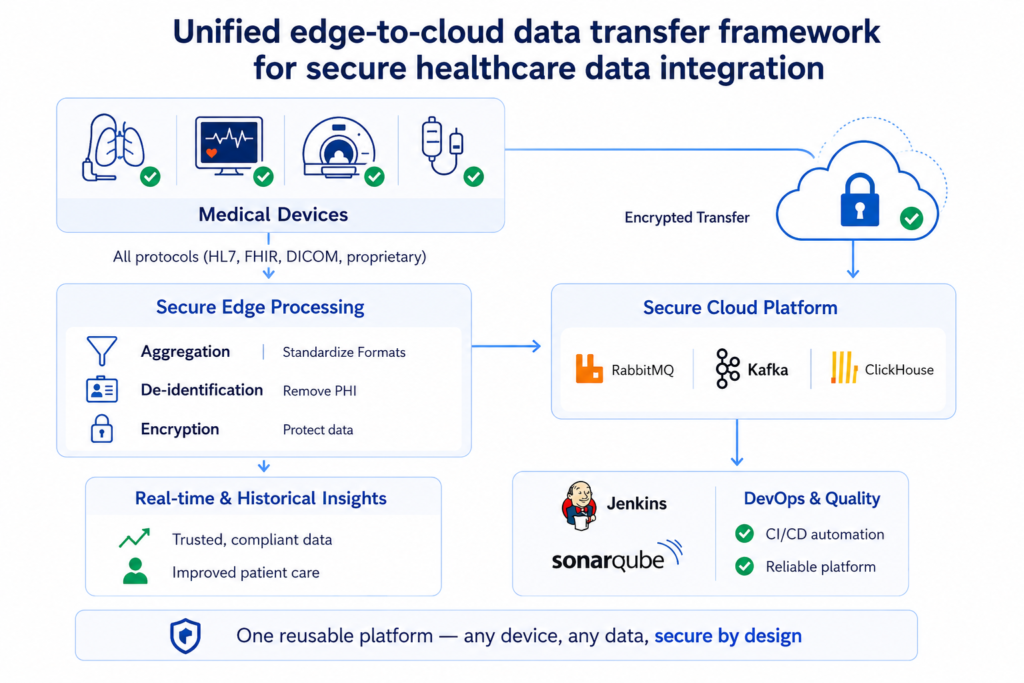
Unified data ingestion from diverse medical modalities eliminated fragmentation. The platform accommodated different device types and protocols through a common framework rather than custom integrations.
Edge-based aggregation, transformation, de-identification, and encryption ensured data was secured and governed at the source. Privacy controls applied before data left the clinical environment, not as an afterthought during analysis.
Secure transmission of governed data to the cloud maintained protection throughout the journey. Data moved through encrypted channels with audit trails documenting every transfer.
Real-time and batch processing pipelines supported both immediate clinical needs and deep analytical work. Clinicians access current patient data while analytics teams explore historical patterns.
Scalable microservices architecture using RabbitMQ, Kafka, AWS, and ELK provided the flexibility to handle variable data volumes and integrate new devices without architectural changes.
Automated CI/CD and quality controls with Jenkins and SonarQube ensured platform reliability. Code quality checks and automated testing caught issues before they affected clinical operations.
What Changed for Healthcare Operations
Device data moved from fragmented pipelines to a single, unified framework. Teams now access all medical device data through one consistent interface instead of navigating multiple disconnected systems.
Data quality and consistency improved through structured ingestion and validation. Analytics teams trust the data enough to act on insights without extensive verification.
Security and compliance enforced at the edge, not as an afterthought. De-identification and encryption happen before data leaves clinical environments, reducing regulatory risk.
Real-time access to device data enabled faster analytics and insights. Clinicians see current patient status while operations teams identify care improvement opportunities from fresh data.
A reusable data backbone simplified onboarding of new devices and use cases. Adding a new device type became a configuration task, not an integration project.
What This Means for Your Healthcare Organization
Secure and compliant medical data transfer protects patients and organizations from regulatory exposure. Faster access to real-time and historical device data accelerates clinical decisions and operational improvements. Reliable analytics across care environments reveals patterns invisible when data remains fragmented. A scalable foundation supports AI and advanced analytics that previous data quality couldn’t enable. Reduced integration effort for new devices means innovation accelerates rather than stalling on infrastructure.
Why This Matters
This framework turns medical device data into a trusted, always-available asset. Organizations often have abundant device data but can’t rely on it for critical decisions because it arrives late, inconsistently, or with uncertain compliance status.
By enforcing governance, security, and scalability from edge to cloud, healthcare providers gain the confidence to act on insights—improving outcomes, efficiency, and care delivery at scale. The shift from “we have device data” to “we trust our device data for clinical and operational decisions” fundamentally changes what healthcare organizations can accomplish.
Ready to build reliable healthcare data infrastructure? If your medical device data is too fragmented or inconsistent to support confident decision-making, let’s talk. NeST Digital specializes in secure, scalable healthcare platforms that turn device data into dependable clinical and operational intelligence.