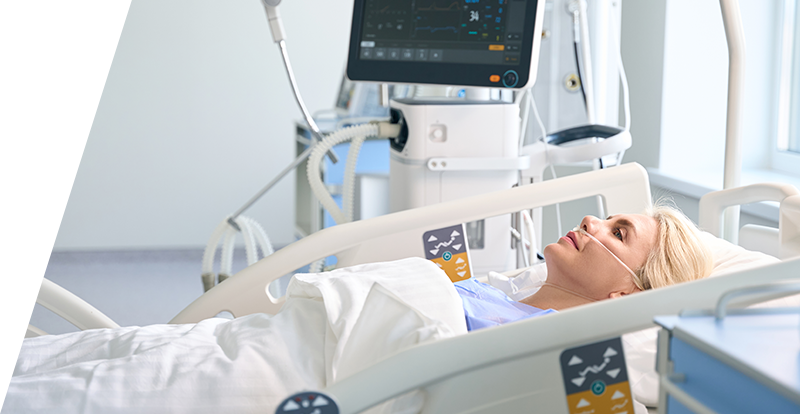
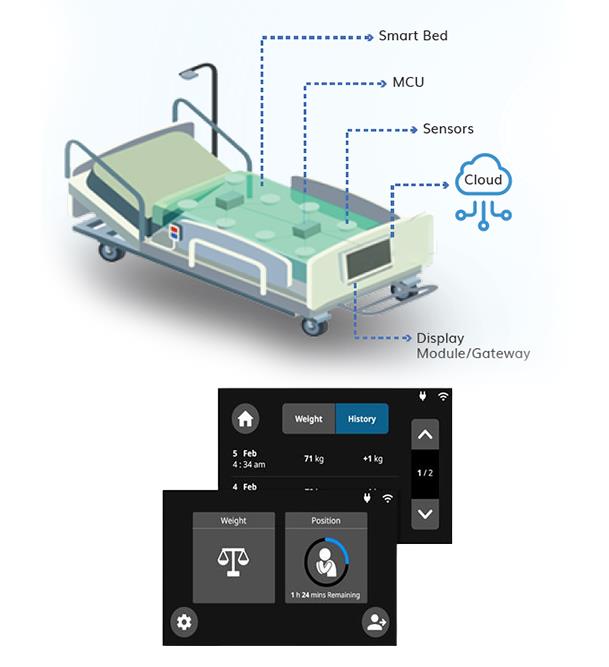
The Smart ICU Bed Embedded System redefines patient care by continuously monitoring critical parameters such as weight, lying position, and geo-location. Data is seamlessly transferred to the cloud for real-time analysis and alerts, while a bedside display module enables clinicians to access and act on live patient data instantly.
Challenge
Modern ICUs face increasing demands for precision, speed, and integration:
Preventing pressure ulcers and other patient risks through continuous monitoring.
Ensuring accurate, real-time data capture and transfer for immediate clinical action.
Integrating sensors, displays, and communication within a single, reliable system.
Solution
The SMEs at NeST Digital developed the Smart ICU Bed Embedded System to bring intelligence and precision into critical care. By combining advanced hardware and software integration, the system transforms patient monitoring into a real-time, data-driven process.
At its core, embedded sensors and a microcontroller track the patient weight, position, and movement with precision and accuracy. Real-time monitoring ensures continuous updates, sending automated alerts for any anomalies that demand quick intervention by the medical team. The interactive bedside display keeps critical data visible, while the NB-IoT gateway ensures secure, seamless cloud connectivity for instant data transfer. Adding to its versatility, GPS/AGPS tracking enables precise bed location, streamlining logistics and enhancing ICU workflow efficiency.
This innovative design ensures smarter, safer, and faster patient care in today’s high-demand healthcare environments.
The Impact
Higher Radiologist Productivity: Streamlined workflows reduced time spent retrieving and comparing studies.
Faster Clinical Decision-Making: Rapid access to comparison studies improved diagnostic accuracy and speed.
Improved Diagnostic Precision: Enhanced MPR measurements and annotation tools supported more accurate diagnoses.
Seamless Collaboration: Cross-enterprise integration improved communication and coordination across teams and locations.
Standards Compliance: Full adherence to DICOM, EMR integration protocols, and security frameworks ensured data integrity and interoperability.